Chapter 53 — Globalisation
Cambridge International AS & A Level Economics (9708) · Unit 11.6 · 4th edition coursebook
Learning objectives
- Define the meaning of globalisation.
- Analyse the causes and consequences of globalisation.
- Analyse the difference between a free trade area, a customs union, a monetary union and full economic union.
- Explain the difference between trade creation and trade diversion.
Key terms
- globalisation
- The process by which the world is becoming increasingly interconnected through trade and other links.
- trade bloc
- A regional group of countries that have entered into trade agreements.
- free trade area
- A trade bloc where member governments agree to remove trade restrictions among themselves.
- customs union
- A trade bloc where there is free trade between member countries and a common external tariff on imports from non-members.
- monetary union
- A trade bloc which involves member countries operating the same currency, having one exchange rate and the same interest rate.
- full economic union
- A trade bloc where there is free trade between member countries, a common external tariff, common economic policies and the same currency.
- trade creation
- Where high-cost domestic production is replaced by more efficiently produced imports from within the customs union.
- trade diversion
- Where trade with a low-cost country outside a customs union is replaced by higher-cost products supplied from within the customs union.
53.1What is globalisation?
Globalisation involves the world becoming one market as the barriers to the movement of goods and services, direct and portfolio investment, and workers come down. The world is becoming more like one country, with fewer restrictions on where people buy products, where firms set up production, and where workers work.
Households now buy products from a wide range of countries; stock exchanges sell shares and government bonds worldwide; multinational companies spread their production around the globe. Restrictions on the movement of workers are still tighter than on goods or capital, but a number of countries are heavily reliant on migrant labour, and within trade blocs workers can usually move and work freely between member countries.
The causes of globalisation
Four main forces have driven the breaking down of barriers between product, capital and labour markets.
- Advances in communications and technology. Firms can co-ordinate the production process across the world and stay in contact with production plants at much greater distance. This has driven the growth and influence of multinational companies. Households can also buy products, and firms can sell products, almost anywhere.
- Improvements in transport. Greater speed, more reliability and lower cost have made it cheaper to move parts between factories and finished goods between countries.
- Removal of trade restrictions. Cutting tariffs lets firms in different countries compete on more equal terms and so promotes international trade.
- Removal of restrictions on where firms can produce. Limits on foreign firms buying out domestic firms or setting up in a country have declined, allowing production to spread across borders.
Indicators of globalisation
Globalisation is measured in several ways: how world trade has grown relative to world output (the world trade to world output ratio); a country's exports to GDP ratio (which indicates how integrated it is in the global economy); flows of portfolio and direct investment, often measured as an FDI to GDP ratio either for individual countries or for the world; and flows of migrant workers and international migration figures.
The consequences of globalisation
Globalisation can drive economic growth. It encourages countries and regions to specialise in what they are best at producing — making greater use of comparative advantage — and so should raise global output and, in turn, living standards. Where firms compete on more equal terms because of lower trade barriers and lower transport costs, lower prices can result, raising consumer surplus and giving consumers a greater variety of products. Free movement of direct and portfolio investment also has the potential to reduce income inequality between countries: an MNC setting up in a low-income country may help to raise productivity and wages across that country.
Globalisation also has potential disadvantages. It can create structural unemployment: opening up to international competition expands some industries but shrinks others, and workers who lose their jobs in declining industries may remain unemployed if they are not mobile. Countries also become more exposed to demand and supply-side shocks. A natural disaster in a major raw materials supplier disrupts the output of importing economies. The free flow of portfolio and direct investment carries the risk that capital can be pulled out quickly, with a negative multiplier effect.
Greater mobility of factors of production can also constrain domestic policy. If other governments set low tax rates, a government that wants to spend more — for example to reduce poverty — finds it difficult; there is a risk that social welfare provision falls. Globalisation can also make it harder to impose stricter pollution controls, because MNCs may threaten to leave. It creates a greater need for international policy co-ordination, which is not always easy to achieve. Like individuals within a country, some countries gain from globalisation while others lose out.
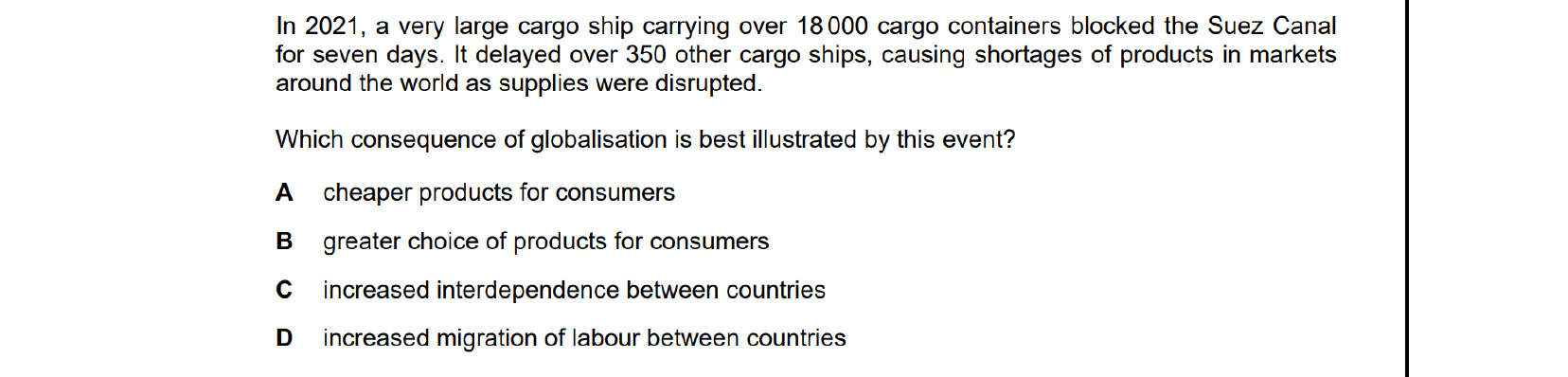
One ship blocks one canal - and shortages of unrelated goods appear across the world. That ripple effect is interdependence: each country's supply chain depends on cargo, components and inputs from many others. So the consequence of globalisation best illustrated by the Suez incident is increased interdependence between countries, not directly cheaper goods, more choice or labour migration.

Over the last 25 years, global growth has been associated with rising resource depletion, more atmospheric pollution and accelerating urbanisation - all visible by-products of expanding production. International trade has grown sharply (rising as a share of world GDP), not fallen. So decreased international trade is the option that has NOT accompanied global growth.
53.2Trade blocs
A large part of the breaking down of barriers to trade and to the movement of portfolio and direct investment and workers takes place within trade blocs. A trade bloc is a regional grouping of countries that have preferential trade agreements between member countries. There are four main types of trade bloc, each representing a deeper stage of economic integration than the previous one.
Free trade areas
In a free trade area, the governments of the member countries agree to remove trade restrictions between each other - tariffs, quotas and other barriers are scrapped on trade within the bloc. The members are allowed to determine their own external trade policies towards non-members and do not share a common external tariff. Each member can therefore set whatever level of tariff it likes on imports from outside the bloc.
Regional free trade areas exist across the world. A complication of free trade areas is that goods can be imported into the member with the lowest external tariff and then shipped on freely to other members; rules of origin are typically used to limit this.
Customs union
A customs union goes a stage further than a free trade area in terms of economic integration. As well as removing trade restrictions between members, members of a customs union agree to impose a common external tariff on trade with non-members. Members countries impose the same tariff on goods imported from outside the bloc, share tariff revenues and co-ordinate some trading policies. The common external tariff removes the rules-of-origin problem found in a free trade area, because the tariff is the same wherever the goods enter the bloc.
Monetary union
A monetary union involves even more economic integration. Restrictions are usually removed not only on the movement of goods and services, but also on the movement of capital and labour, with the aim of creating a single market across members. The defining feature of a monetary union is that the member countries all use the same currency and follow the same monetary and exchange rate policies - one central bank, one interest rate, one external exchange rate.
The European Union illustrates monetary union but goes further still. It operates a single market in goods, services, capital and labour, and its members have adopted common policies on a number of labour-market and social issues. Many members have adopted the euro as a common currency, and the European Central Bank operates a single interest rate for those members. Monetary union has the advantage that exchange-rate risk between members disappears, encouraging trade and investment, but the disadvantage that individual members lose the ability to set monetary policy or to devalue against other members in response to a country-specific shock.
Full economic union
A full economic union is the final stage of integration. A full economic union involves the members having the same currency and following the same monetary, fiscal and exchange rate policies. In effect, the different economies become one economy. An historical illustration is the gradual integration of several previously separate states into a single nation, with a single currency and unified macroeconomic policy.
Convergence criteria and the comparison of trade blocs
Each step up the ladder of integration requires more convergence between member economies. Members of monetary unions and economic unions typically agree convergence criteria covering items such as budget deficits, public debt, inflation rates and interest rates, and a country may be required to meet these criteria before it can adopt the common currency. The looser the bloc - a free trade area, for example - the fewer of these constraints apply. Membership, depth of integration and the aims of trade blocs often change over time, so it is worth keeping up to date with at least two trade blocs when preparing for essay questions.
It is also useful to compare the trade pattern of countries within and outside a deep trade bloc. Countries with most of their trade concentrated on one partner gain easily from any preferential agreement with that partner, but become vulnerable to a downturn in their partner's economy. Countries with a more diversified trade pattern are less exposed to a single partner's fortunes but may benefit less from membership of any particular bloc.
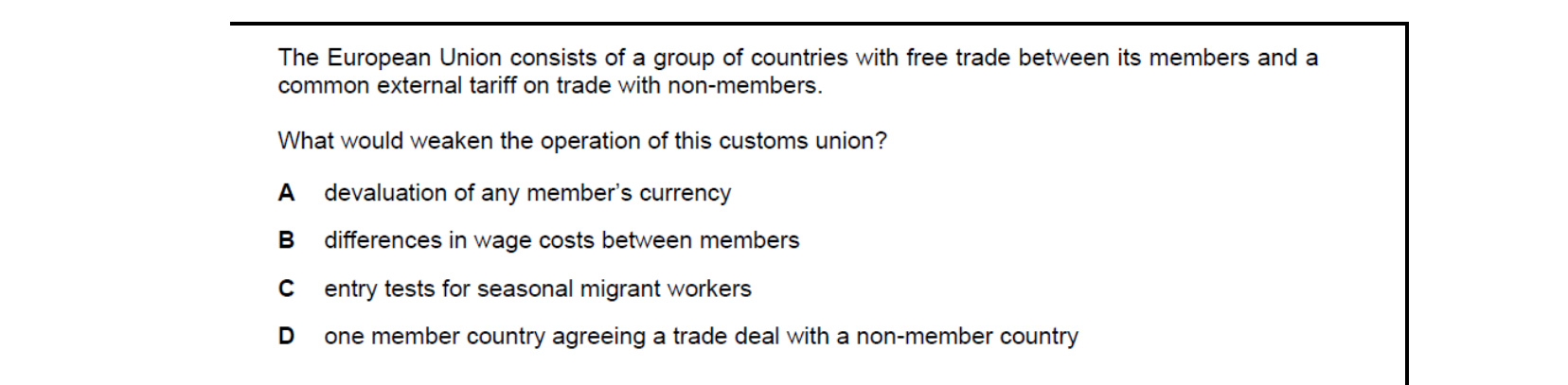
A customs union has both internal free trade and a common external tariff. If one member country signs its own trade deal with a non-member, goods can enter via that member at a different tariff and circulate within the union, undermining the common external tariff. The other options do not breach the union's core design, but an individual member's external deal directly weakens it.
53.3Trade creation
Membership of a trade bloc can lead to trade creation (see Figure 53.8) — the replacement of more expensive domestic production by cheaper imports from another member country with comparative advantage. Efficient firms within the bloc can sell into a larger market, allowing further economies of scale and possibly still lower prices.
The trade creation diagram
The standard diagram shows the country's domestic demand and domestic supply curves. Before joining the bloc, the country imports the product from a partner that — after the tariff is added — supplies at price P. At this price, total quantity consumed is Q, of which Qa is supplied by domestic producers and (Q − Qa) is imported. When the country joins the bloc, the tariff on imports from the partner is removed, so the supply price from within the bloc falls to P1, below the original tariff-inclusive price. Total consumption rises to Q1, the share supplied by domestic producers falls, and imports from within the bloc rise.
Consumers gain from the lower price and higher quantity consumed — consumer surplus rises by four area pieces labelled a, b, c and d on the diagram. Domestic producers lose: producer surplus falls by area a. The government loses tariff revenue equal to area c. The net welfare gain is therefore (a + b + c + d) − a − c = b + d, two efficiency triangles. Trade creation lets imports be purchased more cheaply and, since other members lose tariff protection at the same time, also lets the country sell more exports. Domestic producers who lose sales may also shift resources into products in which the country is now more price-competitive within the bloc.
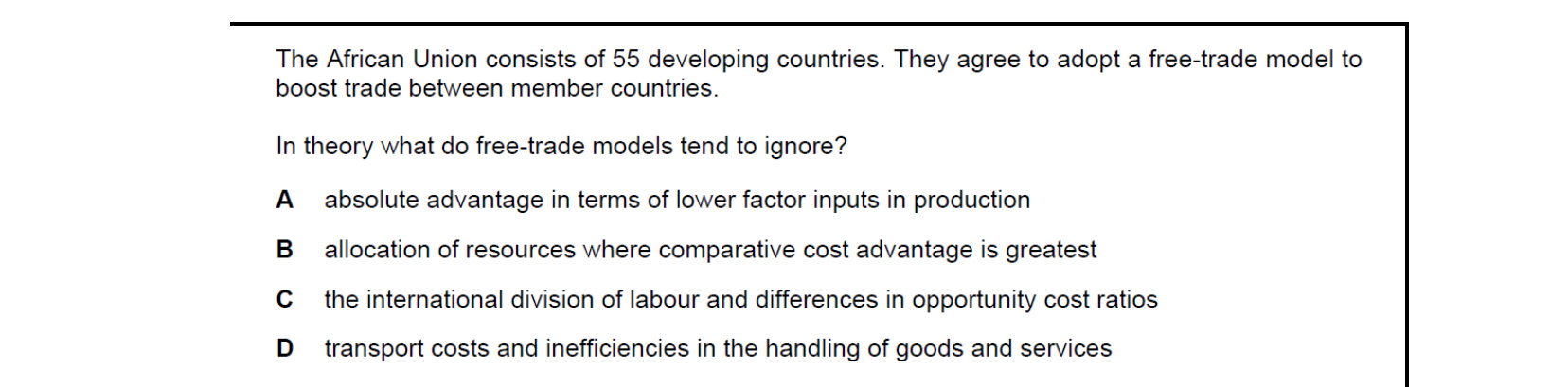
Free-trade models assume goods can flow seamlessly between countries. In reality, shipping, port handling, customs delays and infrastructure bottlenecks add costs that the pure model ignores. The theory does explicitly use absolute and comparative advantage, the international division of labour and opportunity cost ratios - what it leaves out are real-world transport costs and handling inefficiencies.
53.4Trade diversion
Trade diversion (see Figure 53.9) occurs when joining the bloc shifts a country's imports from a low-cost producer outside the bloc to a higher-cost producer inside the bloc. The reallocation is less efficient. Efficient non-member producers lose because they no longer trade on equal terms. The country joining the bloc may also lose overall.
The trade diversion diagram
The diagram again uses domestic demand and supply, but now there are two relevant external supply curves — a low-cost producer outside the bloc and a higher-cost producer inside the bloc. Before joining, the country imports from the lowest-cost (outside) supplier, applies a tariff, and faces a tariff-inclusive price P. Quantity consumed is Q and the government collects tariff revenue equal to areas c + e on the diagram. After joining, the country switches to importing from the partner inside the bloc. The price to consumers falls to P1 (the inside-bloc supply price, with no tariff). Consumption rises to Q1.
Consumer surplus again rises by a + b + c + d. Producer surplus falls by a. But this time the government loses tariff revenue equal to c + e — not just c, because trade has also been diverted away from the cheaper outside supplier on which tariff revenue was previously collected. The net welfare effect is therefore (b + d) − e. If areas b and d together are smaller than area e, welfare falls — the cost of buying from a less efficient inside-bloc supplier outweighs the consumer-surplus gains.
Key concept link — Time
Some of the effects of joining a trade bloc are experienced immediately, such as the price of imports from other member countries falling. Other effects are experienced over time, such as the growth of industries through being able to sell to a larger market and take advantage of economies of scale.
Key concept link — Efficiency and inefficiency
Trade creation and trade diversion illustrates that membership of a trade bloc may have different effects on efficiency.
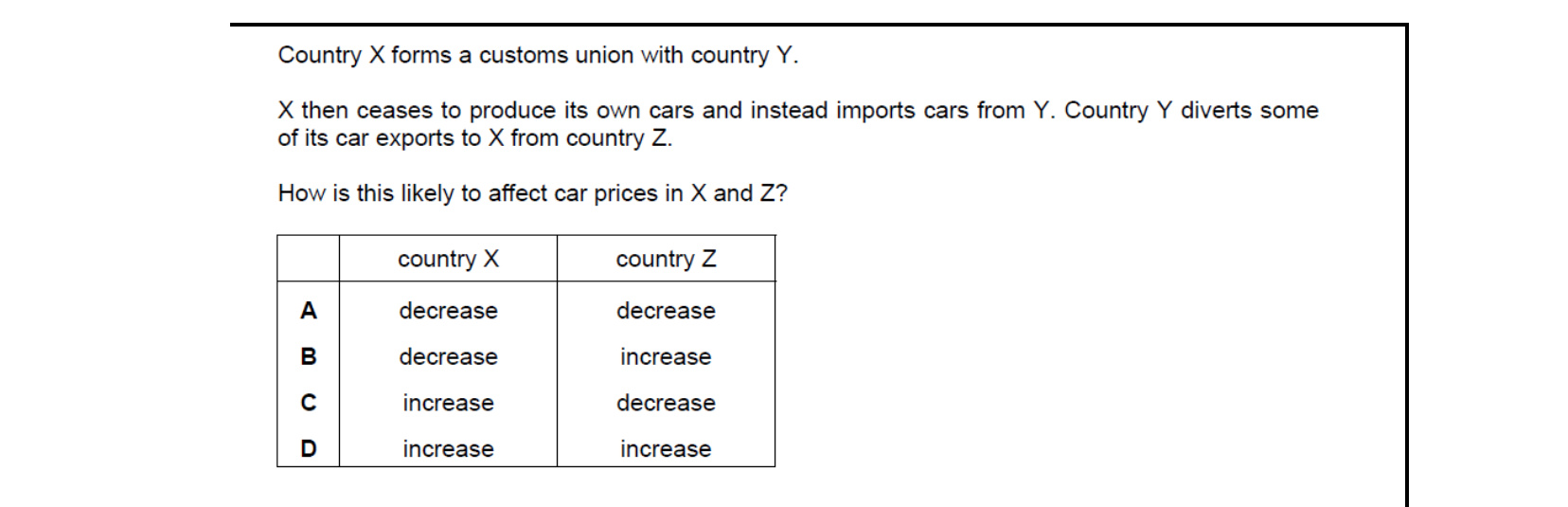
After the customs union, country X buys cars from partner Y instead of producing its own - competition from Y plus removal of any internal tariff push car prices down in X. Meanwhile country Z, which previously exported to X, has lost a buyer; its diverted output now floods Z's own market or alternative markets, putting downward pressure on prices in Z too. So prices fall in both X and Z.
End-of-chapter practice
Past-paper questions from CIE 9708. Pick A, B, C or D. Answers are saved on this device — press Download report (PDF) at the top to save them.
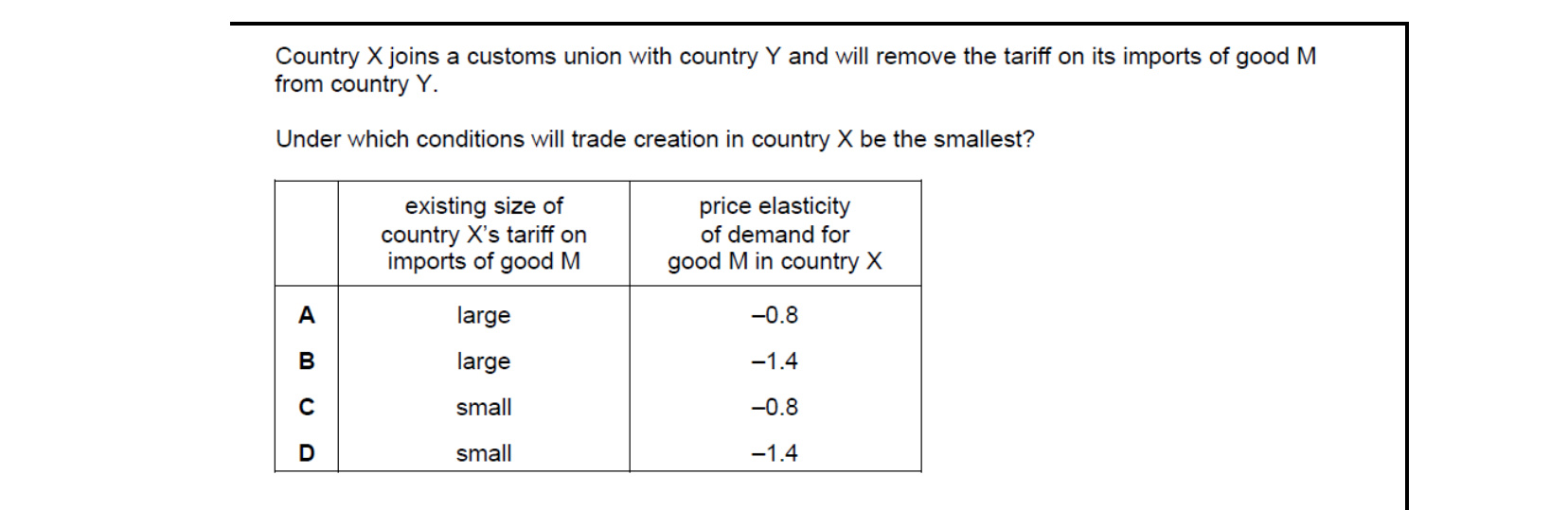
Trade creation is bigger when removing the tariff causes the biggest price fall and the biggest demand response. A large starting tariff means the price falls a lot when it is scrapped; high elasticity means consumers respond strongly. The smallest trade creation therefore comes from a small starting tariff (small price fall) combined with low elasticity (-0.8). Hence option C.
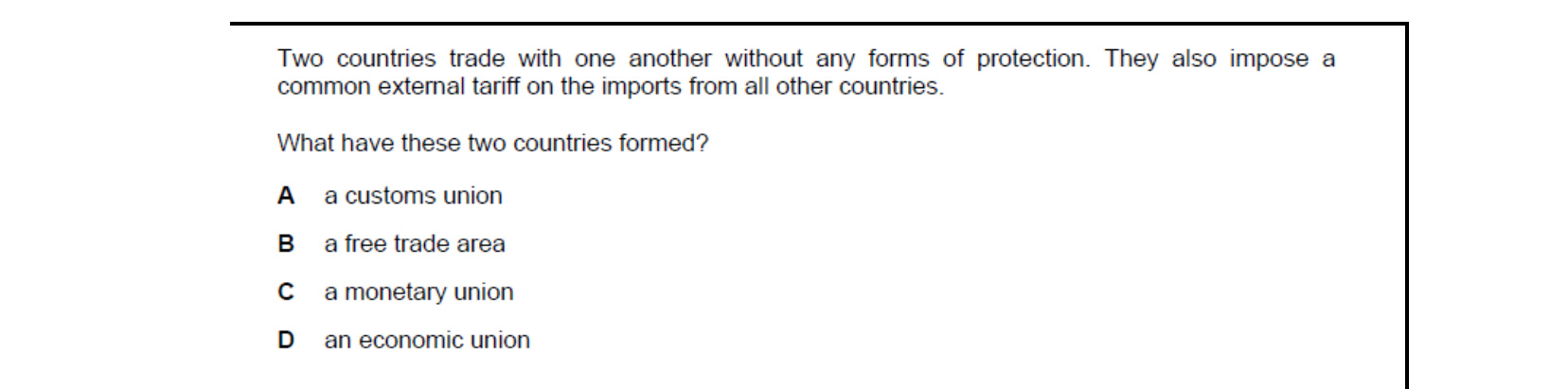
Two countries trading freely with each other and applying a common tariff to everyone else have, by definition, formed a customs union. A free trade area has no common external tariff (members keep their own). A monetary union requires a shared currency, and an economic union goes further still by harmonising broader policy. Only the customs union matches the description exactly.
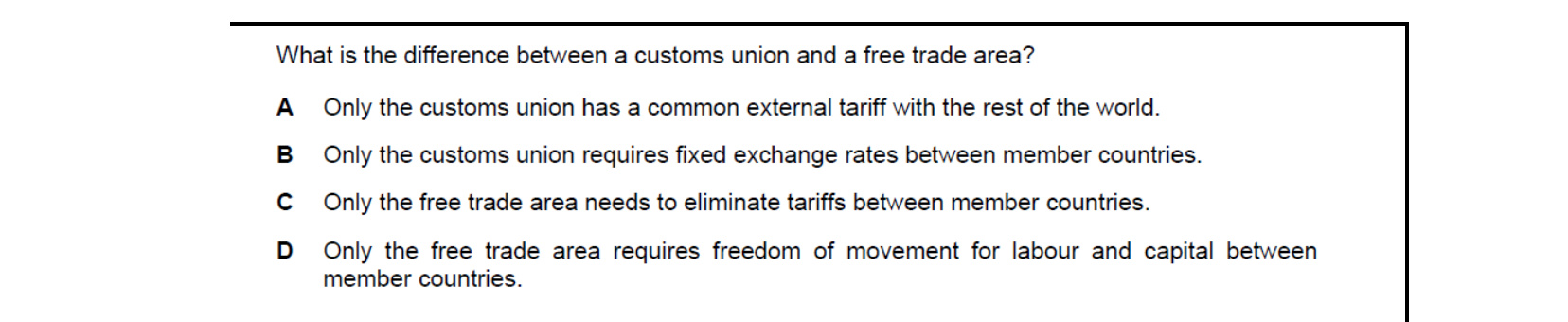
A customs union has both internal free trade and a common external tariff. A free trade area shares the first feature only - members set their own external tariffs. So what is present in a customs union but absent from a free trade area is precisely a common external tariff with the rest of the world.

A free trade area only eliminates tariffs among members; each can set its own tariff on outside imports. A customs union goes one step further by adopting a common external tariff. Monetary systems, tax harmonisation and free factor movement belong to deeper forms of integration (monetary or economic union), not the distinction between FTA and customs union. So the difference is the common external tariff.
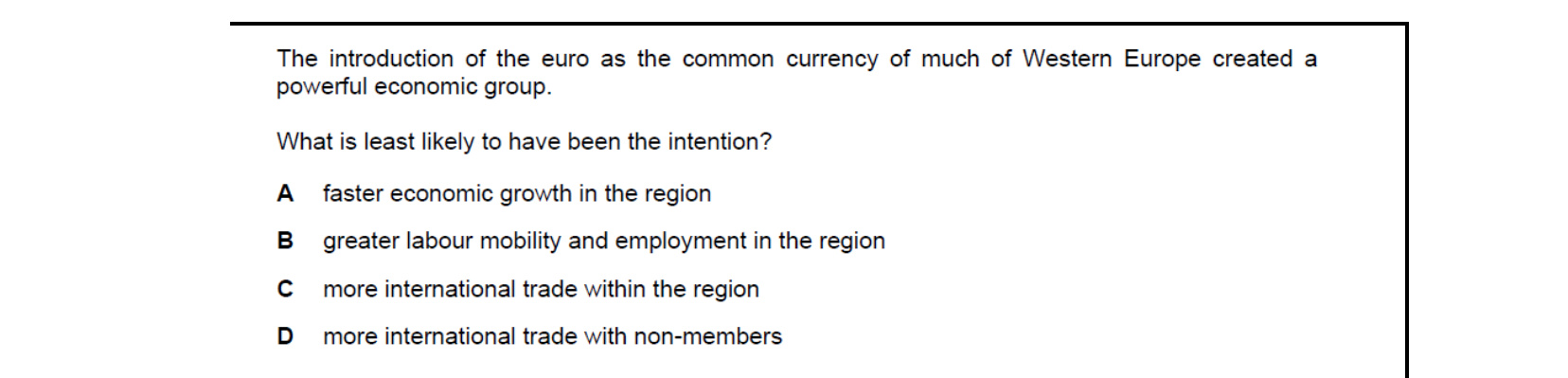
The euro was launched to deepen integration within the bloc: faster regional growth, more intra-bloc trade and easier labour mobility were all intended consequences. The single currency does not directly aim to boost trade with non-member countries; if anything, by reducing transaction costs within the bloc, it can divert some trade towards members. So 'more international trade with non-members' was least likely to be the intention.
Attempt the practice questions above to build your score.
Self-evaluation checklist
After studying this chapter, you should be able to:
- Understand that globalisation involves the world becoming one market as a result of a reduction in the barriers to the movement of goods and services, direct and portfolio investment and workers.
- Analyse the causes and consequences of globalisation.
- Recognise the difference between the different types of trade bloc: free trade area, customs union, monetary union, full economic union.
- Explain that membership of a trade bloc can increase trade (trade creation) or divert trade (trade diversion) away from more efficient producers to less efficient producers.
Want more practice? Drill this chapter's past-paper MCQs (28 questions) →